Email marketing strategy | Tips for boosting ticket sales
In this guide, you’ll learn how to create a practical email marketing strategy for events. We’ll look at the types of emails event organizers send, how to choose the right email marketing platforms, and simple ways to improve the performance of your campaigns.
Share
Email marketing strategy | Tips for boosting ticket sales
A well thought-out email marketing strategy can be an incredibly powerful promotional tool for any business.
For event creators, it plays a powerful role across the entire event journey, from building relationships with subscribers before tickets launch to gathering post-event feedback. Most importantly, it helps you turn a highly engaged audience into ticket buyers.
In this guide, you’ll learn how to create a practical email marketing strategy for events. We’ll look at the types of emails event organizers send, how to choose the right email marketing platforms, and simple ways to improve the performance of your campaigns.
Browse the guide to learn:
What an email marketing strategy is
How email marketing strategy boosts event ticket sales
The key emails to send before and after events
How to choose the right email marketing platform
How to build an event email funnel
Best practices for high-performing campaigns
The email marketing metrics worth tracking
Inspiring email marketing examples for events 💫
What’s an email marketing strategy?
An email marketing strategy is a structured plan for using email to communicate with an audience and achieve marketing goals. These goals might include increasing sales, building relationships with subscribers, or encouraging repeat engagement.
The strategy usually covers how you collect email subscribers and what types of campaigns you send, as well as when those emails are delivered. It also includes tracking performance so you can improve results over time.
But don’t worry! Despite the marketing jargon, it’s easier than you might think to use email to promote your events – whether you’re looking to sell more tickets to a major festival or grow a thriving community around your local workshop.
Why email marketing is so powerful for event creators
Important fact: If you’re promoting events, your email list is one of your most valuable assets. Unlike social media, you own your email audience and can communicate with them directly when tickets launch or updates matter most.
The resulting impact is not to be sniffed at. Businesses earn around $36 for every $1 spent on email marketing, making it one of the highest-ROI marketing channels available. Engagement is strong too, with average open rates sitting around 40% across industries. Email marketing can help you:
Boost registrations and ticket sales by promoting launches, early-bird tickets, and last-chance reminders to engaged subscribers.
Build an engaged community by rewarding subscribers with exclusive announcements or pre-sale access.
Strengthen long-term loyalty by staying in touch between events.
Create a smoother event experience by sharing helpful details like transport tips, schedules, or insider highlights.
Email marketing for events: Which emails should you send?
Your email marketing campaign will include a series of emails that guide subscribers from initial interest to post-event engagement.
Most event campaigns include emails sent before the event, to ticket holders, and after the event. Each stage supports a different goal and helps build a stronger connection with your audience.
Emails to send before your event
Before tickets sell out, your emails focus on building excitement and encouraging registrations. This stage is where most promotional campaigns happen.
Examples include:
Event announcement emails introducing the event and opening ticket sales
Early-bird reminders encouraging subscribers to secure discounted tickets
Speaker, performer, or lineup reveals to build anticipation
Last-chance emails as ticket deadlines approach
These emails help keep your event visible in your subscribers’ inboxes while gently encouraging them to book.
Emails for ticket holders
Once someone has bought a ticket, your email strategy shifts from promotion to experience-building. The goal is to help attendees feel prepared and excited.
Useful emails at this stage include:
Confirmation and welcome emails after purchase
Event reminders as the date approaches
Practical information like schedules, venue details, or transport tips
Extra highlights like featured sessions, performers, or activities
These emails help reduce confusion while building anticipation for the event itself.
Emails to send after the event
The relationship with your audience should continue after your event is finished. Post-event emails help maintain engagement and prepare the ground for future events.
Typical post-event emails include:
Thank-you emails to attendees
Feedback surveys to gather insights
Links to photos, recordings, or resources from the event
Early announcements or teasers for upcoming events
Follow-up emails help turn first-time attendees into loyal supporters who return to future events. Nice 🙌.
✅Key takeaway: Plan your event email marketing as a simple journey. Send promotional emails before the event, helpful updates to ticket holders, and follow-ups afterwards to keep the relationship going and encourage people to return to future events.
Choosing the right email marketing software
The right email marketing software can make running campaigns a whole lot easier, helping you to manage your subscriber list and send campaigns efficiently. Plus, it means you can track how your emails perform over time.
When comparing platforms, look for features like:
Easy audience management so you can organise subscribers and segment your lists
Email automation tools for sending reminders, follow-ups, and nurture campaigns that can be triggered based on certain times or actions.
Campaign analytics to track opens, clicks, and other email marketing metrics
Simple integrations with your ticketing platform and other marketing tools
User-friendly email builders that make designing emails quick and straightforward
The best email marketing software for events
Most email marketing platforms aren’t designed specifically for events… but that’s ok! You really just want to choose a tool that makes it easy to run time-sensitive campaigns, manage subscriber lists, and communicate with attendees.
The platforms below are reliable, easy to learn, and offer the features needed to support an email marketing strategy for events. Bingo.
A popular choice for creators running small to mid-sized events. Mailchimp offers a user-friendly email builder, simple audience segmentation, and helpful automation tools for reminders or follow-up emails.
A powerful option if you want more advanced automation. ActiveCampaign allows you to build detailed email sequences, segment audiences based on behaviour, and create personalised campaigns.
Best suited to organizers running larger events or managing complex marketing campaigns. HubSpot combines email marketing with CRM tools, making it easier to track subscriber activity and nurture long-term relationships.
Hubspot is a full CRM platform so there’s a lot of functionality here that you may not need if all you need to do is send emails.
Hubspot pricing can also rack up, you’ll be charged the monthly fee for their marketing software + a charge depending on how many marketing contacts you have. This is free for the first 2000 contacts but costs after that.
A reliable platform designed with simplicity in mind. Constant Contact offers straightforward campaign tools, event-focused templates, and strong customer support, making it a good option for beginners.
💡Tip: Ticket Tailor integrates with popular email marketing platforms like Mailchimp, ActiveCampaign, Constant Contact, and HubSpot, making it easy to sync attendee data with your campaigns. You can also use Ticket Tailor’s Broadcasts feature to send updates to all ticket holders in just a few clicks.
Building up your event email funnel: A step-by-step strategy
An event email funnel simply describes the journey someone takes from discovering your event to eventually buying a ticket.
Instead of sending one-off promotional emails, you guide subscribers through a series of messages that build interest over time. Each email moves them a little closer to attending.
The process doesn’t need to be complicated. A few clear steps can help you turn casual subscribers into enthusiastic attendees.
Grow your list of subscribers
Your email strategy starts with building a list of people who are genuinely interested in your events.
The key here is providing value. We all have 100s of emails in our inbox every week and subscriptions that are out of hand or we’ve lost track of. Getting someone to give away their email is quite a high barrier so you need to be willing to give away value in return.
Value can be given in a number of ways, be it early access to something, offering discounts, or providing knowledge or something of use for your specific audience.
Focus on attracting subscribers who are likely to attend rather than simply growing your list as quickly as possible.
Some effective ways to grow your event email list include:
Adding sign-up forms to your website or event landing pages
Promoting a newsletter on social media
Offering early access or pre-sale tickets to subscribers
Collecting emails during past events or registrations
These simple steps help you to build up an audience that wants to hear about your future events.
Segment your audience
Not every subscriber is interested in the same thing. Audience segmentation allows you to group subscribers based on their interests, behaviour, or past events they attended.
For example, you might create segments like these:
Previous attendees
Subscribers who clicked on a ticket link
People interested in a specific type of event
VIP or early-access subscribers
💡Tip: Most email marketing platforms automatically track subscriber behaviour, like which links people click or which emails they open. This makes it easy to create segments like “people who clicked a ticket link” or “subscribers interested in a specific event”.
Sending targeted emails to smaller groups usually leads to stronger engagement.
Plan your campaign timeline
Event email campaigns work best when they follow a clear schedule.
Planning your timeline helps you stay organised and ensure subscribers hear about your event at the right moments.
A simple campaign timeline might include:
Announcement email when tickets launch
Reminder emails during the sales period
Final call emails as tickets begin to sell out
Practical updates for attendees as the event approaches
Mapping these emails in advance makes it much easier to run a smooth email marketing for events campaign.
Email marketing best practices for successful campaigns
It’s time to get into the nitty-gritty of what makes for a successful email marketing campaign. Ultimately, your emails are only as strong as their click-through rates and how well they convert into actual sales.
These best practices are tried and tested, helping you increase opens, encourage more clicks, and give your event promotion emails the best chance of turning interest into bookings.
Make your emails feel personal
Personalisation is one of the simplest ways to improve engagement. Research shows that emails with personalised subject lines are about 26% more likely to be opened than generic ones.
For event organizers, personalisation can go far beyond adding a first name.
You might:
Recommend events similar to ones someone previously attended
Send early access emails to loyal attendees
Highlight sessions or performers based on past interests
The more relevant your email feels, the more likely subscribers are to open it and click through. It’s worth thinking about how you can leverage AI in this areas too, by giving tools like ChatGPT or Claude context around your email subscribers and events (this doesn’t need to be personal information) it can help you bucket them into your segments and provide the most relevant context for each.
Test your emails before sending
Rather than assuming what will resonate with your audience, testing your emails allows you to find out for real.
Most email marketing platforms allow you to run A/B tests, where two versions of an email are sent to a small sample of subscribers. It might sound like a whole lot of unnecessary admin, but the reality is that even a small change can have a big impact. Some studies show that changing a subject line alone can dramatically increase conversions in email campaigns.
Some things that are worth testing include:
Subject lines
Email layouts
Call-to-action wording
Send times
This is how you really fine-tune your email marketing efforts, helping you to gradually improve your open rates, click-throughs, and ticket sales over time.
Use automation to work smarter
Automation helps you deliver the right message at the right time without manually sending every email.
Triggered campaigns can perform especially well because they’re tied to specific actions.
Examples include:
Confirmation emails after someone buys a ticket
Reminder emails a few days before your event
Follow-up emails after the event ends
Where email can start to get really advanced is if you link it to your web analytics. This level of sophistication comes into play with tools like hubspot which go beyond just the sending of the email and allow you to create rules like “if a contact I have visited my checkout page 10 or more times without buying a ticket send an email with a unique discount code”.
Automated campaigns can achieve much higher engagement rates than standard bulk emails, especially when they’re personalised and sent to smaller segments.
Write subject lines people actually want to open
Your subject line decides whether your email gets opened or ignored. In fact, around 43% of people open emails based on the subject line alone.
Strong event subject lines often include:
A clear benefit or announcement
A sense of urgency or exclusivity
A reference to the event itself
A number as well as words
Personalisation, for example the recipient’s name
For example:
“Early-bird tickets for [Event Name] are now live”
“Final tickets remaining for Saturday’s workshop”
💡Tip: While emojis are fun, research shows they don’t increase open rates. Adding the word “newsletter” to your subject line can also actually decrease your open rates. (That’s not to say you can’t send newsletter content, but that the subject line should be crafted so it feels more enticing.)
Clear, relevant subject lines make it easier for subscribers to recognise the value of your email at a glance.
Send emails when your audience is most likely to engage
Timing plays a bigger role than many event organizers realize.
Sending emails at the right moment can significantly improve both open rates and clicks.
For event campaigns, effective moments often include:
When tickets first launch
When early-bird pricing is about to end
One or two weeks before the event
A final reminder shortly before the event
Spacing emails thoughtfully keeps your event visible without overwhelming your audience.
Nurture interest with email drip campaigns
Not every subscriber will buy a ticket the first time they hear about your event. That’s where email drip campaigns come in.
A drip campaign is a sequence of emails sent over time to gradually build interest and trust.
For events, this might include:
An announcement email
Speaker or performer highlights
Behind-the-scenes updates
Reminder emails as ticket deadlines approach
These sequences keep your event top of mind and give subscribers multiple opportunities to decide to attend.
✅ Key takeaway: Successful event email campaigns combine personalisation, testing, thoughtful timing, and automation. Focus on relevant messages and compelling subject lines so your emails get opened, clicked, and ultimately convert subscriber interest into ticket bookings.
Email marketing examples (and why they work)
Sometimes the best way to understand great email marketing for events is to see it in action. The examples below highlight real event emails used at different stages of an event campaign, along with the subject lines that helped drive opens.
Example 1: Event promotion email that builds excitement
Subject line:The heart of everything happening at Adobe Summit
Where it sits in the funnel: Early promotion / awareness
This email sits near the top of the event marketing funnel. Its main goal is to spark interest and encourage subscribers to register while tickets are still available.
The email works well because it focuses heavily on experience and value. Rather than simply announcing the event, it highlights what attendees will gain: live demos, networking opportunities, and access to industry innovators.
Clear sections break down the event’s main attractions, making it easy for readers to quickly scan the benefits. The call to action is reinforced with a limited-time incentive (“Register by March 20 to save $100”), which adds urgency and encourages faster sign-ups.
Why it works: It focuses on the attendee experience rather than simply promoting the event.
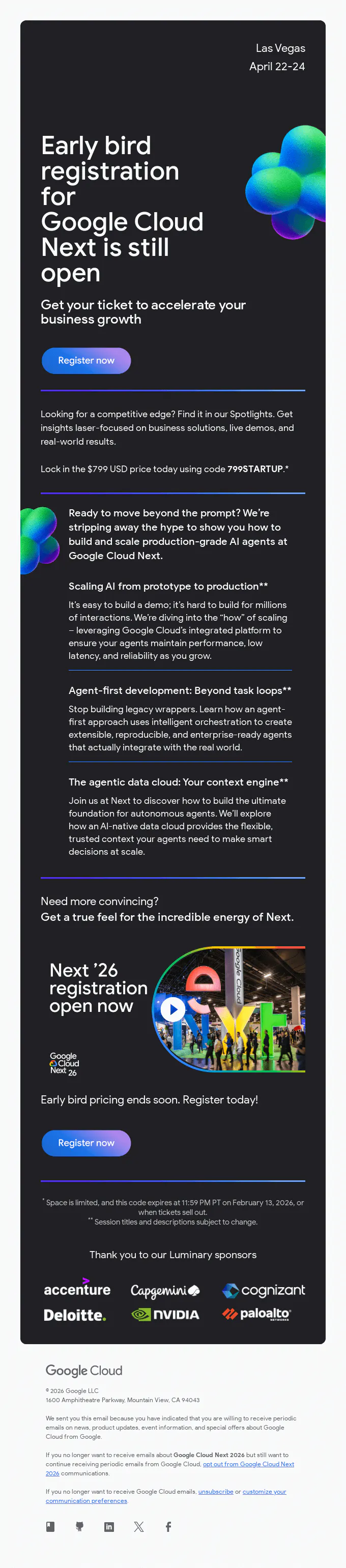
Example 2: Early-bird email that drives urgency
Subject line:There’s more than one good reason to register for Next today
Where it sits in the funnel: Early conversion / early-bird sales
This email sits in the early promotion stage of the event funnel, where the goal is to convert interested subscribers into early ticket buyers.
The email works because it combines a clear incentive with time-sensitive messaging. The discounted early-bird price and promo code create a strong reason to register immediately rather than waiting.
It also highlights specific learning outcomes, like scaling AI systems and building production-ready agents. This helps readers quickly understand the value of attending and who the event is designed for.
Repeated calls to action and reminders that early-bird pricing ends soon reinforce urgency and encourage readers to secure their ticket.
Why it works: A clear discount combined with time pressure encourages early registrations.
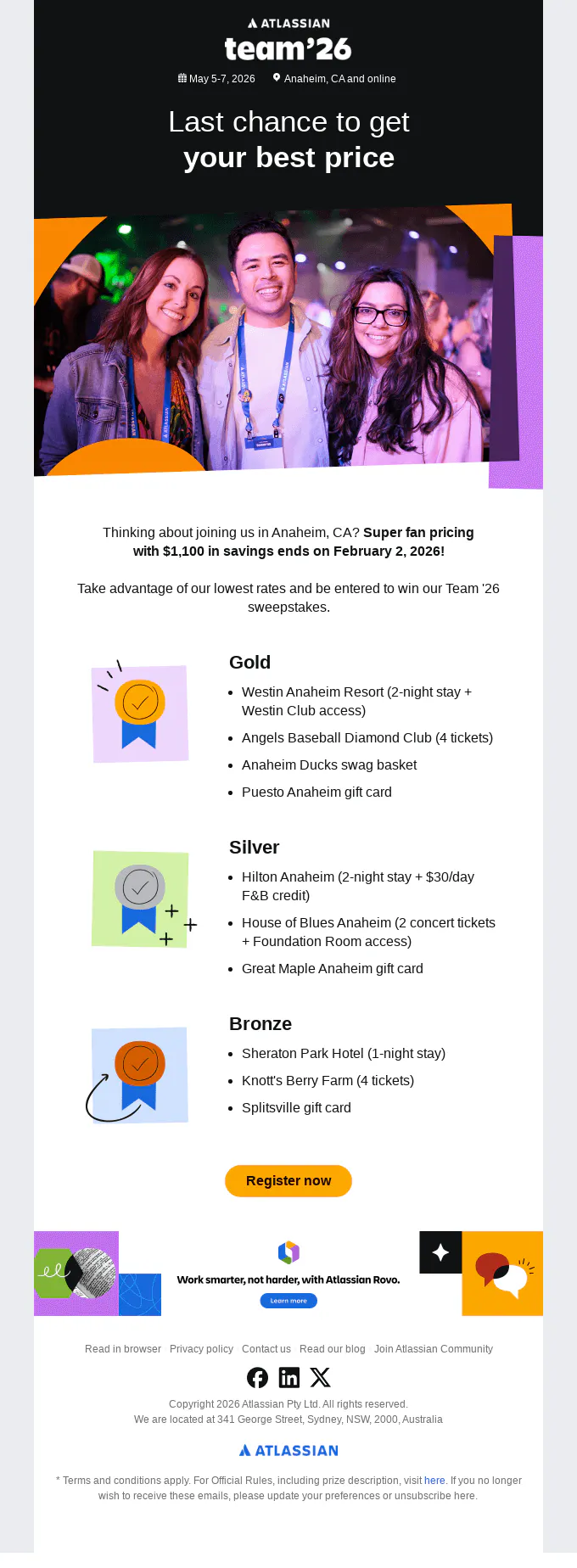
Example 3: Last-chance email that creates urgency
Subject line:⏰ Time is running out – save now on your Team '26 pass
Where it sits in the funnel: Late conversion / final ticket push
This email sits at the late conversion stage of the marketing funnel. Its goal is to encourage subscribers who are considering the event to finally register before pricing increases.
The email works because it leans heavily on urgency and scarcity. The subject line immediately communicates that the lowest ticket price is about to expire, giving readers a strong reason to act quickly.
It also reinforces the value of registering now by highlighting the potential $1,100 savings, making the offer feel tangible and significant.
The sweepstakes element adds an extra incentive, while the clear “Register now” call to action creates momentum for readers who may have been waiting to commit.
Why it works: Scarcity and expiring pricing push hesitant subscribers to finally register.
Example 4: Post-event follow-up that keeps attendees engaged
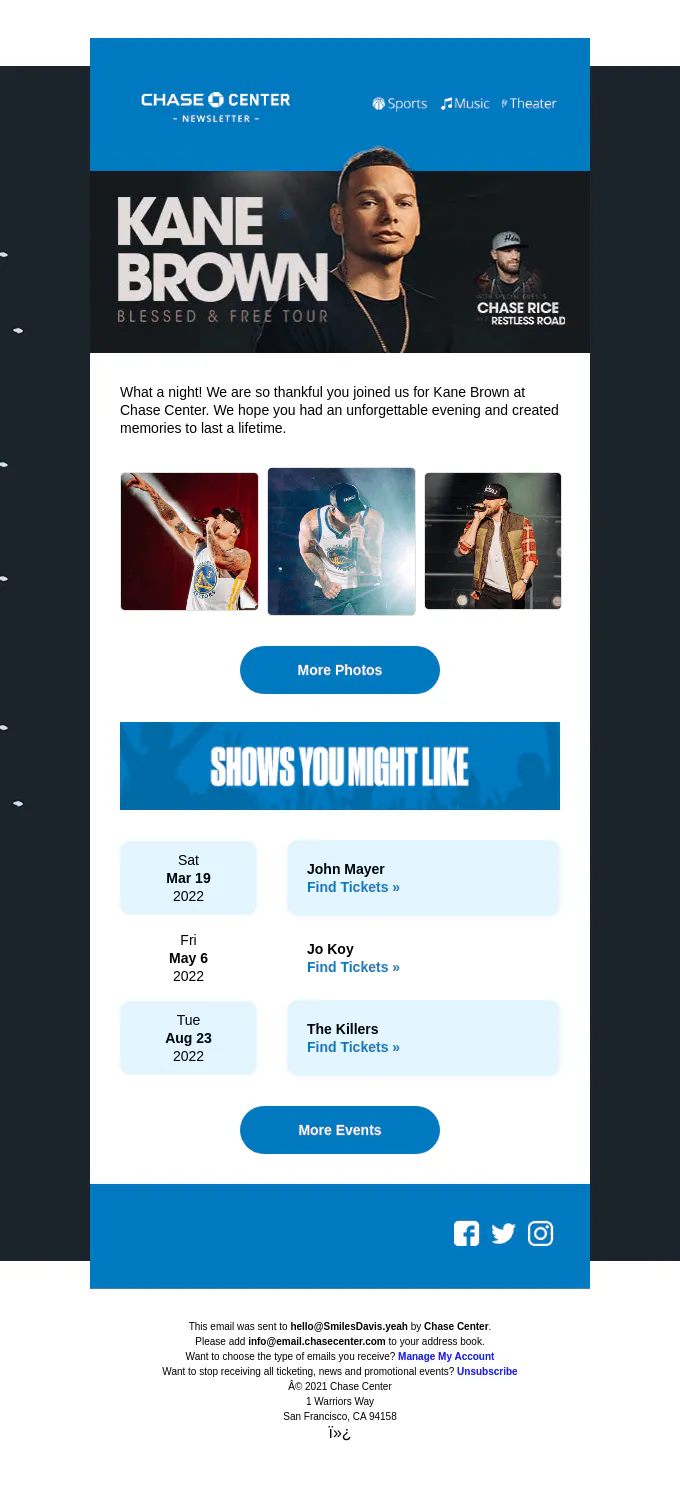
Subject line:[Recipient Name], we hope you enjoyed Kane Brown!
Where it sits in the funnel: Post-event retention
This email sits at the post-event stage of the marketing funnel. Its goal is to strengthen the relationship with attendees and encourage them to come back for future events.
The message works because it begins with a warm thank-you that acknowledges the attendee experience. This helps reinforce positive memories from the event and makes subscribers feel valued.
Including photos from the night extends the event experience beyond the venue. Attendees can relive the moment and share it with friends.
The email also recommends similar upcoming shows, giving readers an easy next step while the event is still fresh in their minds.
Why it works: It strengthens attendee relationships while promoting future events.
Email marketing metrics: How to measure campaign success
Once your campaigns are running, it’s important to understand how they’re performing. Tracking a few key email marketing metrics helps you see what’s working, what needs improvement, and how effectively your emails are driving ticket sales.
Most email marketing platforms provide built-in analytics dashboards, making it easy to monitor your campaign performance over time.
Here are some of the most important metrics event creators should keep an eye on:
Open rate
Your open rate shows the percentage of recipients who opened your email.
This metric is strongly influenced by your subject line, sender name, and timing.
Across industries, average open rates typically sit at around 40%, although well-targeted campaigns can perform much higher.
Click-through rate (CTR)
Your click-through rate measures how many people clicked a link within your email.
For event campaigns, this usually means clicking through to your event page or ticket checkout.
If your open rates are high but click rates are low, your email content or call to action may need improving.
Conversion rate
Your conversion rate tracks how many email recipients actually completed the desired action, like buying a ticket.
This is often the most important metric for event organizers because it directly reflects how effectively your emails drive registrations.
Unsubscribe rate
Your unsubscribe rate shows how many people opted out of your mailing list after receiving a campaign.
A small number of unsubscribes is normal. However, consistently high rates may indicate that emails are too frequent or not relevant to your audience.
Monitoring these metrics helps you refine your email marketing strategy for events over time, allowing you to improve engagement and ultimately sell more tickets.
Your quick email marketing strategy checklist for events
Before launching your next campaign, make sure you’ve covered the essentials:
Build a list of subscribers who want to hear about your events
Plan your campaign timeline from announcement to follow-up
Segment your audience where possible
Test subject lines and email content
Track key email marketing metrics such as opens and clicks
😎Time to turn subscribers into sold-out events
A strong email marketing strategy helps you turn interest into action. Build a list of engaged subscribers, send the right emails at the right moments, and track your email marketing metrics to keep improving your campaigns.
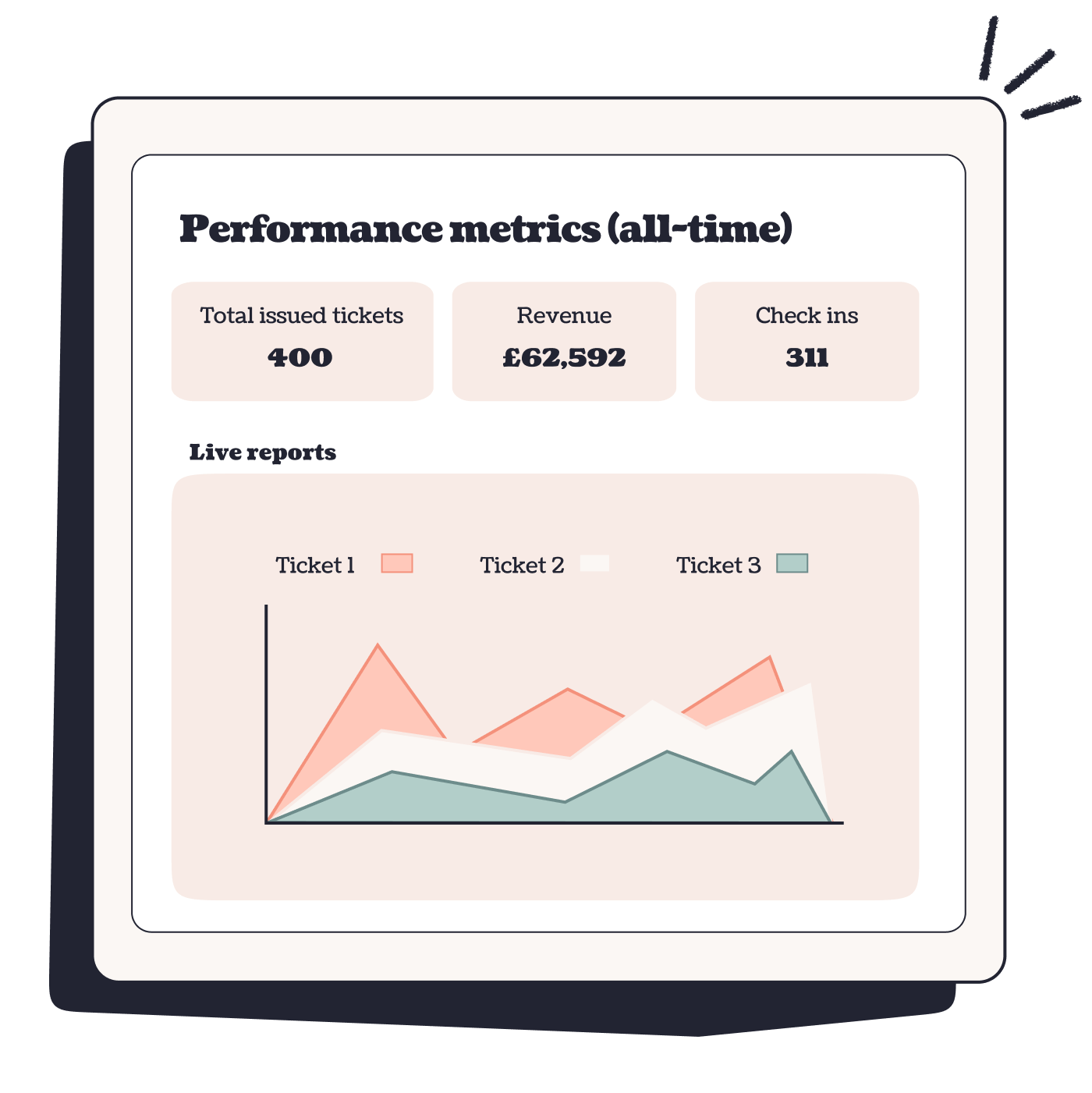
Ticket Tailor helps you turn that momentum into ticket sales. Benefit from seamless integrations with platforms like Mailchimp, ActiveCampaign, Constant Contact, and HubSpot. Plus, enjoy the lowest ticketing fees in the market, super fast 24/7 support, and the good-vibe feeling of knowing you’re helping to support the planet with every ticket sold.