Whether you’ve got a major corporate conference in the works, are planning an industry summit, or want to spark new conversations around a theme close to your heart, this guide is for you.
Share
When attending a conference as a delegate, it’s all too easy to overlook the meticulous scheduling and planning behind the event. Awesome line-up? Check. Delicious canapes? Don’t mind if I do. Bustling networking sessions? Awesome.
But what exactly goes into pulling all of these moving parts together to create one inspirational and memorable experience?
Whether you’ve got a major corporate conference in the works, are planning an industry summit, or want to spark new conversations around a theme close to your heart, this guide is for you. Read on to find out exactly how to plan a conference with detailed step-by-step instructions, a comprehensive checklist, timeline, and expert insights from seasoned conference hosts. Let’s go.
How long does it take to plan a conference?
It’s likely you’ll need to start planning your conference at least a year in advance. Most venues will need to be booked around 9-12 months before the event, and there are naturally a lot of other logistics to consider, from speaker availability to your marketing strategy. Larger scale conferences may need more lead time, up to around 18 months. But smaller, more niche conferences could get away with less.
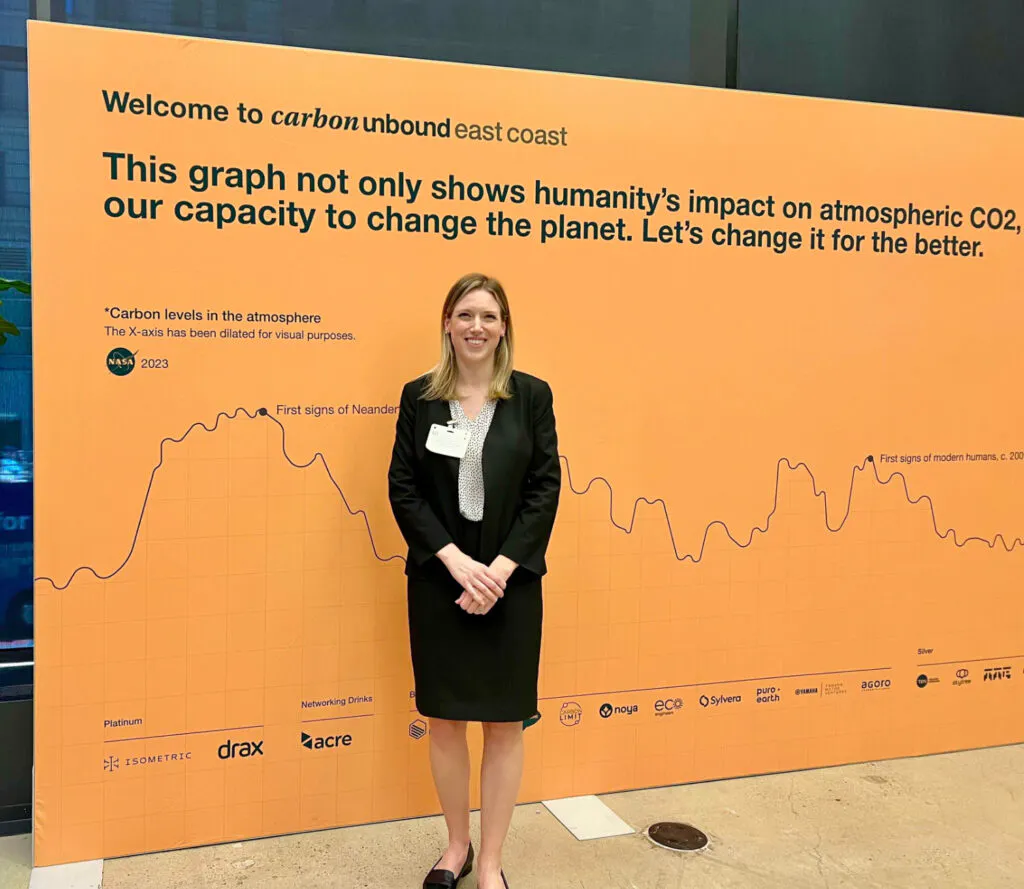
🎤Oliver Katz, CEO and Founder at sustainability summit, Carbon Unbound, says:
“Our event planning takes around six months per event, and thousands of hours go into ensuring every element of the summit is curated and relevant. Our six-strong team meticulously covers everything, including sourcing speakers, choosing a suitable venue, accepting sponsors and even vetting attendees.”
When working out how much lead time to give yourself, consider:
Event size and format: A multi-day, multi-track conference with hundreds of attendees will require more runway than a one-day niche summit.
Venue availability: Popular venues (especially in major cities) can book out 12+ months in advance.
Speaker calibre and availability: High-profile or in-demand speakers might be booked far ahead, too.
Sponsorship timelines: Securing sponsors can take months of outreach and negotiation.
Marketing and ticket sales strategy: You’ll need time to build awareness, run campaigns, and hit revenue targets.
Team capacity: The size and experience of your team will have an impact on how quickly things get done.
Budget complexity: The more moving parts (AV, staging, catering, hybrid tech), the more time you’ll need to source and liaise with suppliers.
What makes a great conference?
A great conference stands out for its depth of content, seamless logistics, and satisfying networking opportunities. Let’s take a closer look.
Clear strategic objectives
Every strong conference starts with purpose. Revenue, brand positioning, community building, policy influence, product education; whatever the aim, it should be clearly defined from the offset.
High-value content
Delegates leave with insights they couldn’t have easily accessed elsewhere. The content feels carefully curated and genuinely thought-provoking.
Energy and flow
Moments of inspiration are interspersed with plenty of space to connect and opportunities to reflect. Delegates feel energised and inspired rather than exhausted and overwhelmed.
Seamless logistics
Attendees are able to flow easily between spaces, talks, and experiences. Clear signage, plenty of on-hand staff, and well designed program materials can all help things run smoothly.
A strong emotional impression
People leave feeling they’ve had a memorable, uplifting, and rewarding experience.
Step 1: Define clear goals for your conference
Before you start planning, take time to really dig deep into the “why” of your conference.
Are you aiming to generate revenue? Position your organisation as a thought leader? Build a community around a shared interest? Launch a new product or initiative? Influence policy? The clearer you are about your purpose, the easier pretty much every decision from here on out will be.
It’s also a good idea to translate your broader ambitions into measurable targets. These could be monetary related, like a specific revenue goal or a ticket sales target. Or you might define success in terms of post-event satisfaction scores or the number of qualified leads generated. These metrics provide direction and also make it much easier to measure the success of your event later down the line.
Step 2: Create a comprehensive budget
You’ll need to outline a detailed budget for your conference before putting any plans into action. Without one, it’s easy to underestimate costs or make commitments that end up being difficult to see through.
To create your budget, begin by mapping out all of your potential expenses. Venue hire will probably be your biggest cost, with others including catering, AV and production, speaker fees and travel, staffing, branding, marketing, insurance, and potentially event technology like apps or streaming platforms. It’s also a good idea to include a contingency buffer of at least 10-15% to cover you for any unforeseen costs.
When it comes to projecting revenue, make a list of all the various streams of income you expect your conference to make. For example, ticket sales, sponsorship packages, exhibitor fees, and any grants or funding streams. If this is your first conference, it’s probably wise to be a little cautious with your projections. It’s much better to underestimate revenue and be pleasantly surprised than to overestimate and find yourself dealing with an unexpected shortfall!
Step 3: Put together a passionate team
Even relatively small conferences involve a wide range of moving parts. So you’ll need a committed team to help you see through important tasks. Working with people who share in your vision and are passionate about the end goal of your conference is a must. You’ll have to spend a lot of time liaising with your team so it definitely helps if you’re all on the same page.
Depending on the size of your event, roles you assign might include:
Conference Director: Vision and decision-making
Project Manager: Timeline and coordination
Commercial Lead: Sponsorship and partnerships
Content Lead: Speaker sourcing and program design
Marketing Lead: Audience growth
Operations Lead: Venue, suppliers, logistics
In some cases, one person might hold multiple roles, but it’s still important that responsibilities are clearly defined.
Make sure your team is equipped with time-saving project management tools. Try:
Trello: A visual task management platform that uses boards and cards to help you track progress across different workstreams at a glance.
Asana: A great platform for managing timelines, assigning responsibilities, and mapping task dependencies.
Notion: Useful as a central planning hub for storing speaker briefs, run sheets, contracts, and internal documentation.
Monday.com: Offers highly customizable workflows that can support everything from sponsorship.
Finally, hold regular check-ins to make sure potential issues are identified early, and everyone maintains a sense of motivation and alignment.
Step 4: Define your conference’s theme
All conferences need a unifying theme; an overarching narrative that provides strong cohesion across everything from the actual content of your event to your main marketing hook.
A strong theme should feel specific enough to offer direction, but broad enough to allow for varied sessions at your event. For example, rather than simply “Sustainability,” a conference might explore “Scaling Climate Innovation” or “Building Circular Economies in Practice.” Instead of “Women in Business,” it could focus on “Redefining Leadership for the Next Decade.”
Once you’ve settled on a theme, you’ll find it a vital tool in guiding speaker selection, session topics, visual branding, and even venue styling. If a proposed session doesn’t align with the overarching theme, it’s worth reconsidering whether it’s right for your event.
Step 5: Set a date
Selecting the right date requires more thought than simply choosing a free slot in the calendar.
Think about the broader industry landscape. Are there major competing events around the same time? Does your target audience typically attend trade shows or sector gatherings at certain points in the year? Are there seasonal factors, school holidays, or cultural observances that could impact attendance?
For many business-focused conferences, mid-week dates tend to perform well. But the best choice ultimately depends on your audience’s habits and availability. Once confirmed, your date should be locked in before substantial marketing begins to avoid confusion or reputational damage from changes.
Step 6: Choose a location and venue
Your conference’s setting can be the thing that tips those on-the-fence attendees in the right direction. Factors to consider include transport links and nearby accommodation (for those staying overnight), as well as how fitting the location and venue feel for the theme of your event.
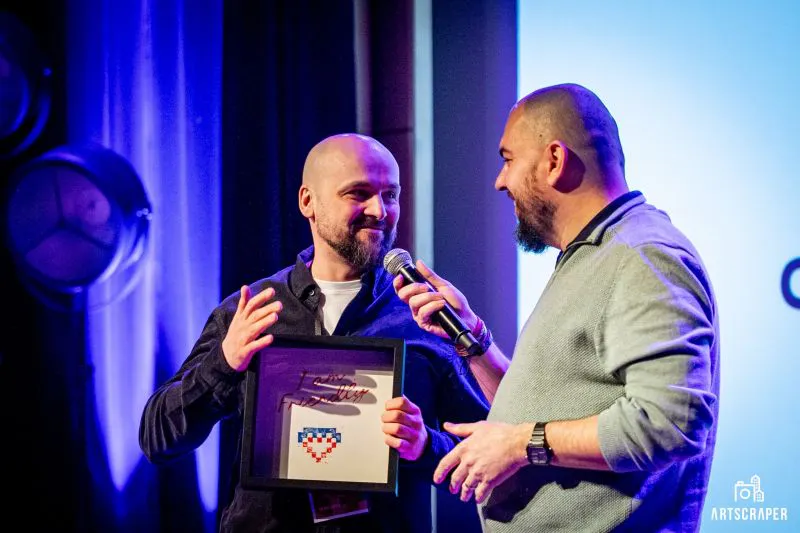
🎤On this topic, Adrian Marin, creator of developer conference Friendly.rb, says:
“I live in Bucharest and so, first and foremost, I wanted things to be as manageable and low-effort as possible from a logistics point of view. Especially considering that Friendly.rb is the first event of this size that I’ve organised.
But also, Bucharest is generally a great city to host a conference. There are plenty of good flight connections, tons of beautiful architecture (Bucharest used to be called ‘Little Paris’!), and the city is safe and quite cheap to live and travel in.”
When assessing venues, pay close attention to practical considerations like:
Room capacity and flexibility: Does the space comfortably accommodate your expected numbers, with room for breakout sessions if needed? Flow between spaces: Is it easy for delegates to move between registration, main stage, breakout rooms, and catering areas without congestion?
Built-in technical capabilities: What AV equipment is included, and will it meet your production needs? WiFi reliability: Can the network handle hundreds of devices simultaneously, particularly if you’re running live demos or streaming?
Accessibility: Is the venue fully accessible for disabled attendees, including step-free access and appropriate facilities?
Sustainability credentials: Does the venue align with your environmental values or those of your audience?
Step 7: Book your line-up of speakers
The speakers at your conference will be the primary reason delegates buy tickets, so be sure to give yourself plenty of time to source a stellar line-up that’s likely to appeal to your audience.
Aim for balance: established names who can draw attention, alongside practitioners or emerging voices who bring fresh insight. Diversity in perspective, background, and experience strengthens both the program and your event’s credibility.
When evaluating potential speakers, watch recordings of previous talks to assess their clarity, engagement style, and ability to deliver practical value. And begin outreach early, especially for high-demand speakers! Provide clear briefs outlining your audience profile and expectations regarding format and timing. Professional preparation on both sides will lead to stronger sessions that align with your conference theme and goals.
🎤Friendly.rb’s Adrian, has some useful insights about the process and impact of securing a winning line-up:
“What was great was that our keynote speakers said yes before we actually announced the event [...] Having set the stage with such great speakers from the offset, others soon followed. Half of the speakers we secured are quite well-known and the other half are just getting started [...] I believe we were able to secure such a great [line-up] because we just showed potential speakers that we really mean business – that we want to put on a great experience for speakers and attendees alike.”
Step 8: Secure Sponsorship
For many conferences, sponsorship is what makes the event financially viable. It can offset venue and production costs, reduce ticket prices, or increase overall profitability.
If you want to go down the sponsorship route, start by identifying the types of organisations that would benefit from exposure to your audience. Who shares the same target market? Who’s already investing in events or industry visibility? The strongest sponsorships feel aligned and mutually beneficial.
Next, create structured sponsorship packages. These might include:
Headline or title sponsorship
Stage or session sponsorship
Exhibition stands
Branded networking sessions
Digital visibility (website, email, social media)
Speaking opportunities
Be transparent about what sponsors receive and how success will be measured.
It’s also important to price packages realistically. Research comparable events if possible, and make sure the benefits justify the investment. Undervaluing sponsorship can undermine perceived quality, while overpricing without a clear audience proposition can stall sales.
Begin outreach early, ideally 6–9 months before the event, and approach potential sponsors with a proposal outlining your audience demographics, projected attendance, theme, and promotional plan.
Once sponsorship is secured, keep communication consistent and focus on delivering the agreed benefits. That way, you’re much more likely to secure the same sponsors for future events.
Step 9: Create your conference agenda
Now it’s time to shape the actual experience of your conference from start to finish.
A well-constructed agenda balances intensity with breathing space. Consider how energy levels typically rise and fall throughout the day and aim to create a program that flows with this.
🎤Incorporating interactive elements can significantly enhance engagement. As Oliver explains:
“Interactive elements are integral to delivering value to our attendees and the industry. We spend a lot of time in the ideation phase, thinking of new formats that allow for insight sharing, collaboration and networking opportunities. It’s not just our speakers who have a wealth of knowledge but also our attendees, and we want them to have opportunities to share it!”
Workshops, facilitated roundtables, and structured networking sessions allow attendees to contribute rather than simply absorb information.
Try to have fun with this stage of conference planning! Ultimately, this is where your vision and mission come together, and is the perfect time to think both creatively and strategically in bringing your goals to life.
Step 10: Organise catering
Great thinking requires fuel! Even the most inspiring talks will fall in deaf ears if the owners of those ears are hungry, tired, and in need of a coffee. Which is why this is a crucial element of your conference planning to get right.
It might be that your venue is able to offer catering, or that you need to hire an external provider. Either way, some tips for ensuring everything runs smoothly:
Collect dietary requirements at registration and make sure all food is clearly labelled with allergens.
Consider sustainability and waste reduction where possible, especially if your audience values environmental responsibility.
Pay attention to pacing. Coffee breaks and lunch intervals should feel generous enough to encourage conversation without causing the day to overrun.
Not every conference requires formal entertainment, but carefully chosen additions can make for a more dynamic and memorable experience.
Think: an experienced MC to maintain energy and keep sessions running on time, or atmospheric live music during a drinks reception. For evening programming, a comedian or special guest could see the day end on a high.
Step 12: Source and test your equipment
Work with experienced AV providers and schedule rehearsals in advance. Test microphones, slide formats, lighting, and, if relevant, live streaming platforms. Always make sure backup equipment is available where possible. Even small efforts, like making sure you’ve got spare clickers or additional microphones, can prevent minor issues from escalating into major disruptions.
Step 13: Set up ticketing and consider launching a website
Your ticketing platform plays a direct role in conversion. A complicated checkout process or unexpected fees can put potential attendees off at the final hurdle.
Look for a platform that offers transparent pricing, flexible ticket types, and reliable reporting tools. Other useful features to look for include the ability to offer discount codes, easily communicate with ticket buyers, and customize your box office.
At this stage, you might also think about setting up a dedicated website for your conference – hiring a web developer or using a web builder platform like Wix or Squarespace.
💡Tip: Not every conference needs a website – Ticket Tailor’s box office design feature allows you to create a pro-feeling, customizable event page that’s both beautifully designed and on-brand. If you’re working with a limited budget, skipping the website and using a bold event page in lieu can be a great way to save some cash.
Which ever route you go down, your website and/or event page should clearly communicate:
The what, why, who, when and where of your conference: What it is, who should care about it and why, who’s speaking at it, and its date and location.
Any useful information for attendees – for example, around transport and accommodation.
Clear calls-to-action – for example, to buy tickets now.
A way for ticket buyers to get in touch.
Step 14: Promote your conference
Promoting your conference will require a phased and consistent strategy.
Begin with a clear announcement once the date and venue are confirmed, followed by periodic speaker reveals and agenda highlights. Encourage confirmed speakers and sponsors to share the event with their networks, and equip them with ready-made assets to make this easy.
There are lots of different marketing channels you might consider depending on the nature of your conference and what resonates with your audience.
LinkedIn can be valuable for B2B conferences. And social media channels like Instagram and TikTok can also be powerful promotional tools for events across a wide range of topics and industries.
💡Tip: We have a comprehensive guide to marketing events through TikTok, guiding you through every stage of using the platform as a powerful promo tool.
Think about your ticketing strategy, too. Early-bird pricing can help build momentum and improve early cash flow, while group discounts can encourage more sales if your event is likely to be attended by, say, teams rather than individuals. You might also consider creating “Supporter” tickets, giving those who want the opportunity to pay more towards your event. There’ll probably be an element of trial and error for your first event…
🎤 This is something Adrian touches on when discussing their own ticketing strategy:
“We simply released 30 early bird tickets, thinking that this seemed like a good amount. Then, of course, we have our regular tickets, and we also wanted to give folks the ability to help out and support the event, so we added a ‘Supporter’ ticket type, too. We had quite a bit of success with those, selling about 14 in total.”
Step 15: Gather post-conference feedback
Once your event is wrapped up, you’ve got one final task – to understand what went well, what didn’t, and how satisfied delegates were.
To do so, send a feedback survey within 24–48 hours while the experience is still fresh. Ask about overall satisfaction, session quality, logistical organisation, and likelihood of attending again. If sponsors are involved, you might choose to gather their feedback separately to assess return on investment.
It’s also a wise move to hold a structured debrief internally with your team. This’ll give you the chance to get a clear understanding of what worked well and what could be improved. Just be sure to document any insights gained, as they’ll come in really useful if and when you host another conference.
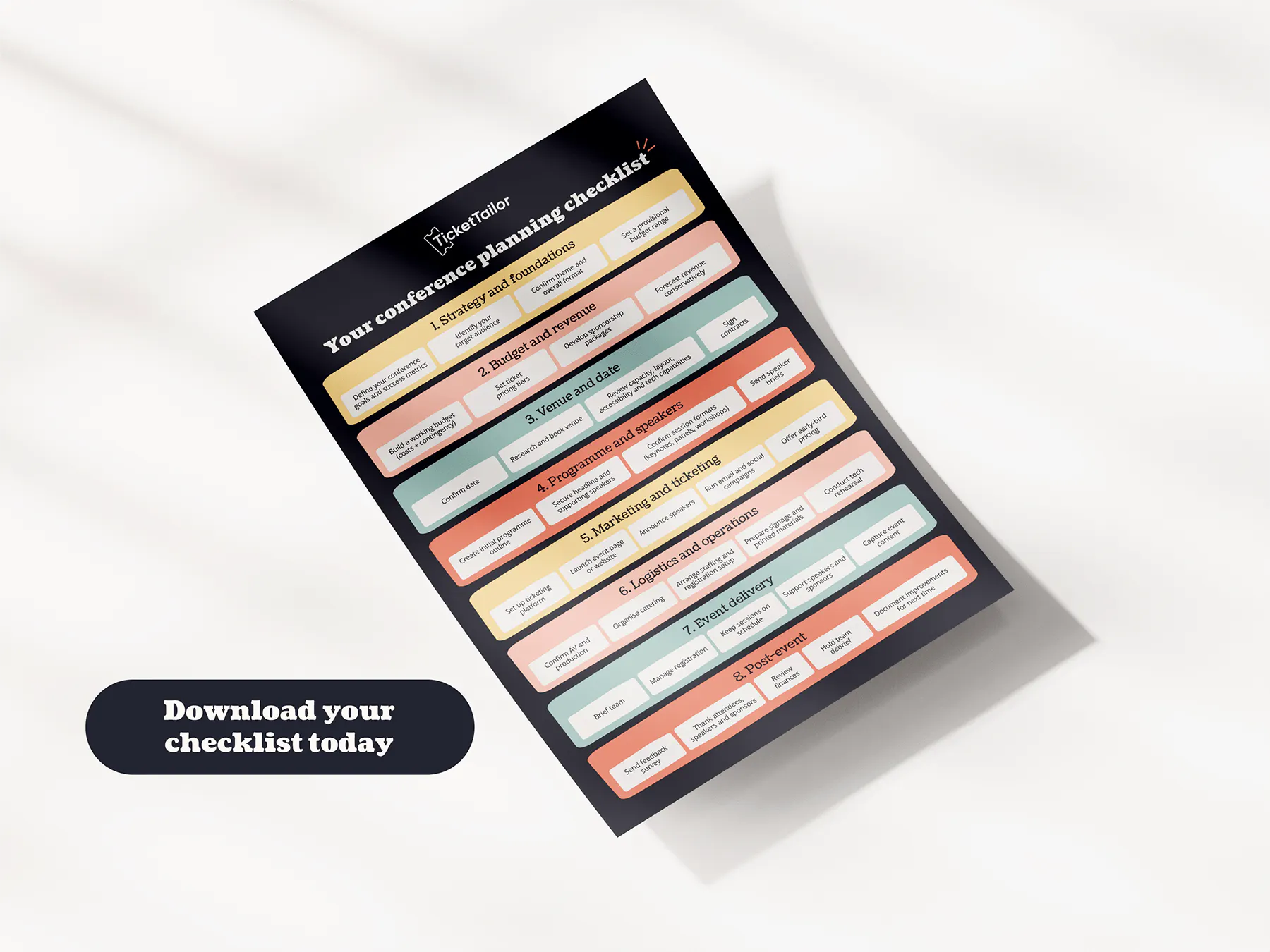
Your complete conference planning checklist
Refer back to this checklist throughout your conference planning process to keep tasks on-track and logistics running smoothly.
Conference planning timeline
Your conference planning timeline will depend on how much lead time you’re running with – but here’s an example of a timeline for a 12-month runway.
12 Months Before
Define objectives and target audience
Confirm theme and format
Draft initial budget
Research venues
9–10 Months Before
Secure venue and confirm date
Refine budget
Begin speaker outreach
Develop sponsorship packages
6–8 Months Before
Confirm key speakers
Launch website or event page
Open ticket sales (early-bird)
Begin marketing campaigns
Start sponsor outreach
4–5 Months Before
Finalise majority of program
Secure sponsors
Confirm AV and production suppliers
Confirm catering direction
Ramp up marketing
2–3 Months Before
Finalise agenda
Confirm speakers’ logistics
Send attendee joining information
Order signage and materials
1 Month Before
Confirm final numbers
Reconfirm suppliers
Conduct tech rehearsal
Brief team
Event Week
Final walkthrough
Deliver event
Post-Event (Within 2 Weeks)
Send feedback survey
Thank speakers and sponsors
Review performance and finances
Hold internal debrief
Bringing your conference vision to life
Planning a conference is no small undertaking. It demands strategic thinking, careful budgeting, creative curation, and meticulous execution – no pressure then! But it’s also one of the most powerful ways to bring people together around shared ideas, challenges, and opportunities.
When you start with clear goals, build a strong team, and stay organised throughout the process, what once felt daunting becomes manageable. Each step in the planning process, from venue selection to speaker briefings, contributes to an experience that has the potential to spark conversations long after the event itself.
🎤To close, some useful advice for first-time conference organizers from Adrian:
“First, definitely talk to past organizers. Don’t be daunted in reaching out to them to ask for advice – you’ll probably find they’re happy to share their secrets and tell you how they do what they do! This can be a great way to gather all the information you need. Secondly… just do it! If you think you’ll enjoy the process, go for it.”
Couldn’t have said it better ourselves 💫.
🎟️ Find out more about ticketing your conference with Ticket Tailor. Enjoy the lowest fees in the market, tons of useful marketing integrations, and a full suite of time-saving, admin-reducing ticketing features.