Best days and times to sell event tickets online (backed by data)
When’s the best time to sell tickets? We analysed millions of sales to uncover the exact days and hours ticket buyers purchase most. From Friday night spikes to payday surges, these insights could transform your event marketing. Discover the data-backed sweet spots that boost ticket sales.
Share
We’re constantly asked for insights to help our event creators sell more tickets. The truth is that every event is different and you will always know best what works for your event and customers. That said, there are some data points that we can draw on to give you the inside track for promoting your events. One of those is helping you find the perfect sweet spot of exactly when to push your ticket sales. So read on for the definitive answer for when the most popular times and days are for buying tickets.
❓Why timing matters for ticket sales
It doesn’t take a genius to calculate that there are 168 hours in any given week (24 x 7 if you were wondering), but you may not realize that in one of those hours you will sell over 35 times more tickets than another. Ok, we know you are probably not going to be launching your ticket on sale email at 4am in the morning, but even gains of 5% can be huge for an event. That could be the difference between making a profit or a loss. In the world of events we know that fine margins matter. This article takes a deep dive into data from millions of tickets sold on Ticket Tailor to find trends that could give your next event the edge.
⏰ What hours of the day are people most likely to buy tickets?
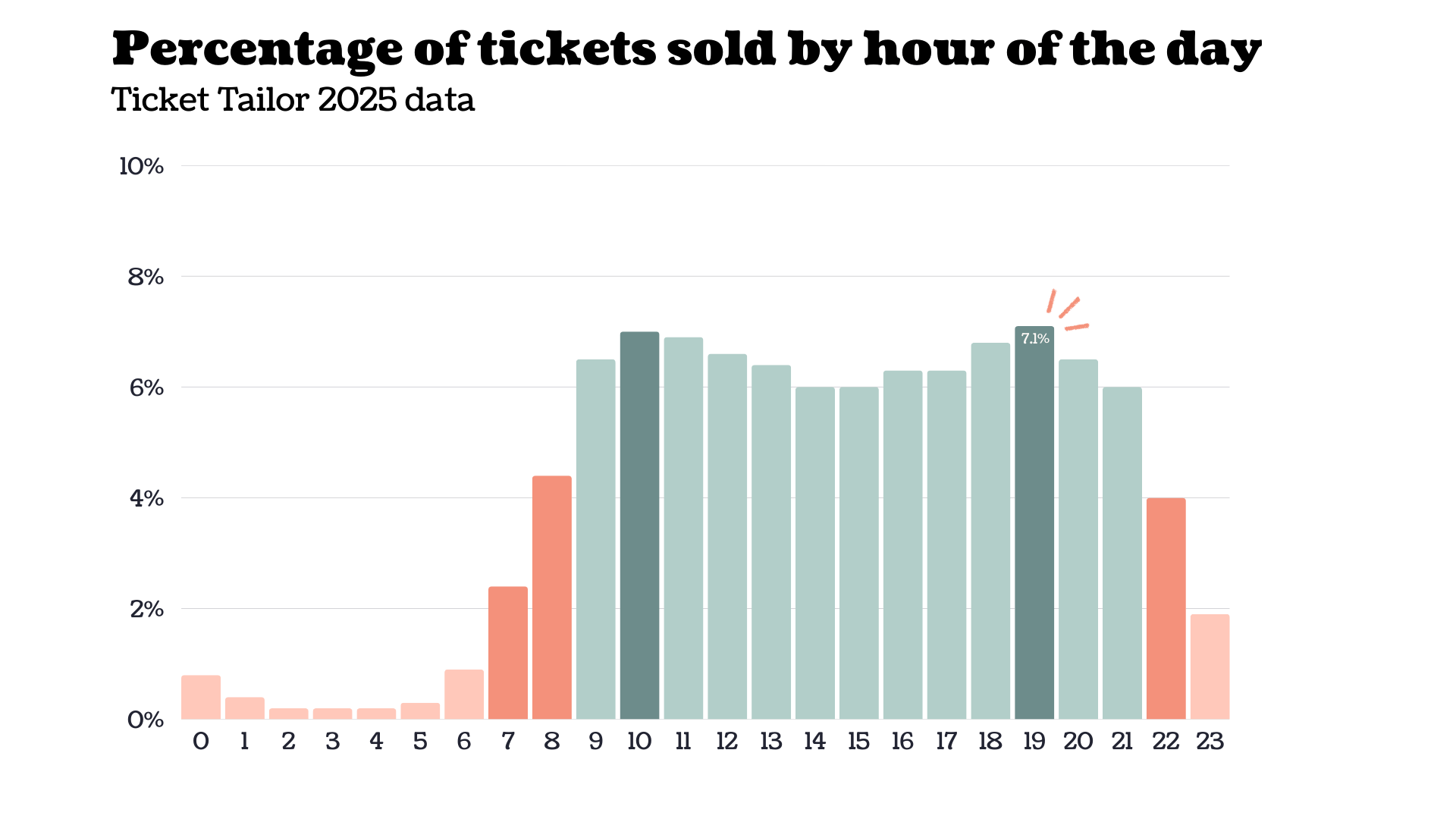
Let’s dive straight into the data. This sample data of over 500,000 ticket sales across over 5,000 events shows what percentage of all ticket sales are sold at any given hour of day.
If tickets were sold evenly across a 24 hour period then each hour would result in 4.2% of tickets being sold. What we actually see is a huge range from as low as 0.2% in the early hours of the morning, to as high as 7.1% in the early evening. That’s a whopping 35.5x difference.
The most popular time of day for tickets to be purchased is between 7pm and 8pm in the evening, with 7.1% of all tickets being purchased in the 60 minute period. This is likely when most people are finished at work, plans have been made throughout the day and ticket buyers are ready to make their purchase.
🧐 Ticket buyer behaviour throughout the day
There are some pretty obvious daily routines that give us indications of when are going to be the most popular times people are likely to be buying tickets vs being preoccupied with other activities (e.g. sleeping!), but it’s interesting to look at each section of the day to understand when to time your events marketing activities.
If we were to break the day roughly into before work, during work, after work and sleeping here is how ticket sales would be split:
Before work (7am - 10am) – 13.3% of ticket sales
During work (10am - 6pm) – 58.2% of ticket sales
After work (6pm - 11pm) – 23.6% of ticket sales
Sleeping (11pm - 7am) – 4.9% of ticket sales
From this breakdown, it makes sense to trigger your ticket on sales in the morning to make the most of any given day's sales, and you should see sales peak in the early evening. If you want to compound a days sales, consider running social ads in the early evening or pushing an extra offer to get people over the line.
📅 What is the best day of the week to sell tickets?
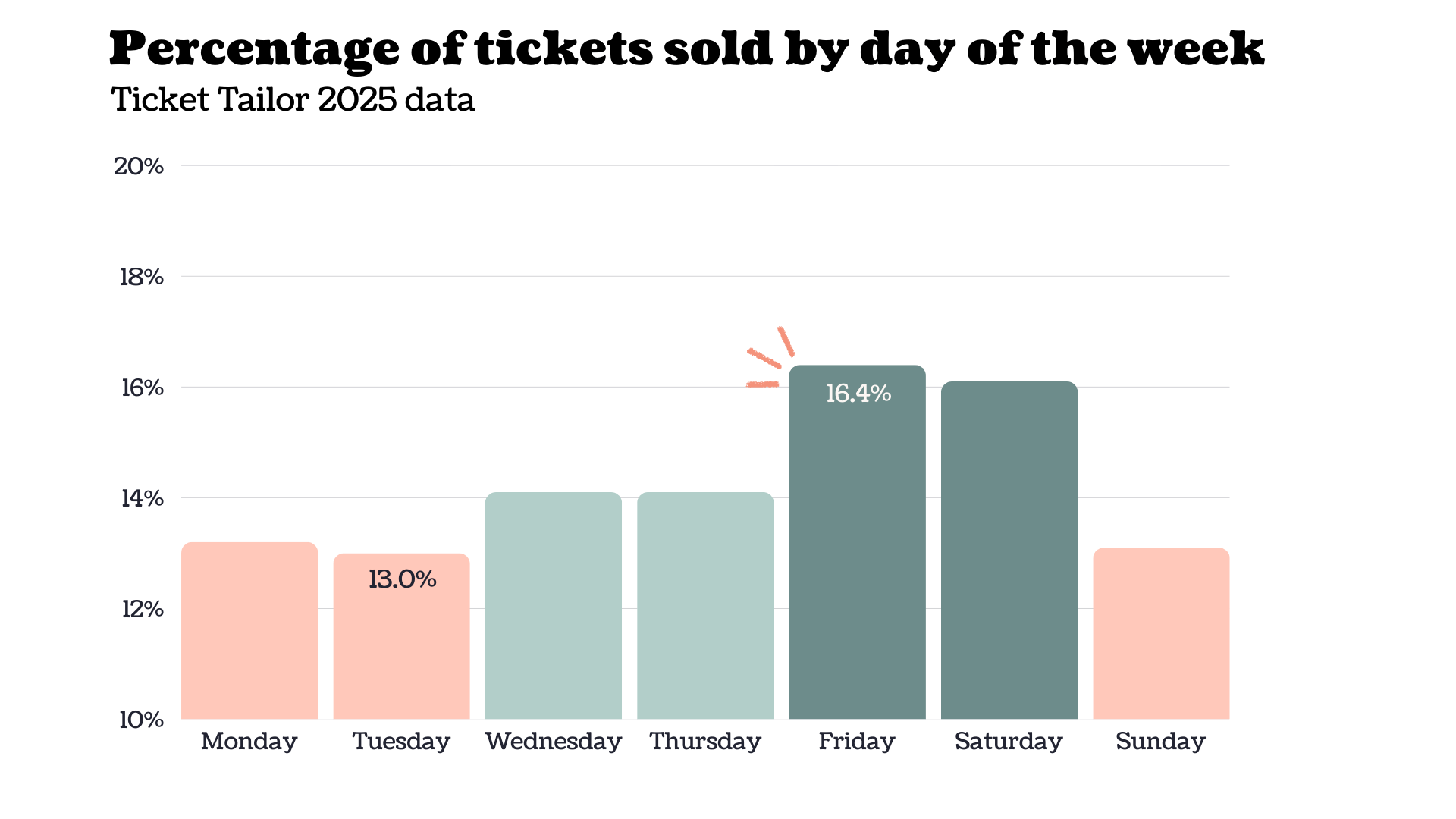
To understand which day of the week is most popular we’ve looked at over 10m ticket sales over a 6 month period to get the conclusive answer on which day is best.
This chart shows the breakdown of ticket sales by each day:
Here’s the full range of percentages of tickets sold by day:
Monday – 13.2%
Tuesday – 13.0%
Wednesday – 14.1%
Thursday – 14.1%
Friday – 16.4%
Saturday – 16.1%
Sunday – 13.1%
Here's the split of tickets sold by weekend and weekday:
Weekdays – 70.8%
Weekends – 29.2%
While tickets sell steadily across the week, some days clearly come out on top. Friday leads the way with 16.4% of weekly sales, closely followed by Saturday at 16.1%. This makes sense as not only are Fridays a time when people start thinking about free time, but it also often coincides with payday and the start of the weekend when events are often taking place.
Midweek is also strong, with Wednesday and Thursday both accounting for over 14% of sales.
Interestingly, despite being a weekend day with less work commitments, Sunday is the 2nd lowest selling day after Tuesdays.
The takeaway? Every day brings in ticket buyers, but leaning into the Friday and Saturday purchasing patterns probably makes sense for most events. That might mean messaging earlier in the week to start to move people towards completing their purchase at the end of the week.
🎟️ What other things should be a consideration when planning ticket sales?
Our data is so large it normalises a lot of unique factors that you may also need to take into account when building your event marketing plan. Here are some of the other top considerations to think about:
Paydays and income cycles – people are more likely to buy tickets when they’ve just been paid, this is a well trodden ecommerce tactic.
Student loan payment dates – similar to the above, but especially important if you have a younger audience.
Calendar events like public holidays – bank holidays may impact sales, changing the most popular days of the week.
Daily weather – any outdoor event will tell you that sales rocket on sunny days, even if the event isn’t until weeks away.
Competitor event marketing – keep an eye out for when other local or similar events are pushing their sales, you may want to avoid or be bold and go head to head!
Marketing cycles – customers can get overwhelmed during periods like Black Friday or January sales so be strategic as to when you want to put messaging out
If you’re getting close to going live, have a think about the above in parallel with your event dates to fine tune when is the perfect time to push your online ticket sales.
✅ The final verdict of the best time and day to sell tickets
Looking at all our available data – the busiest time of day for ticket sales is 7pm in the evening on a Friday night. Use this insight to time marketing messaging, ticketing on sales and drive demand for your event – safe in the knowledge that this is statistically the time of the week your ticket buyers are most likely to be considering a purchase.
That said, you should consider specific nuances for your event, as well as external factors like public holidays and paydays to really nail the timing of your ticketing marketing.
💻 Use your own data to optimise sales
If you have been selling tickets on Ticket Tailor, the good news is that you will have your own data to dive into to gain insights specific to your event.
Head to the Orders tab and export all your ticket sales into Google Sheets or Excel. From here you can use a Pivot table to see which days or times are most popular for your specific events.
Every event is different and specific factors may mean that your event sells differently to the average we see on Ticket Tailor.
🤖 Take your insights to the next level with AI
Did you know you can use Ticket Tailor’s AI Assist to connect your box office to your favorite AI tools? Learn more about how our MCP - listed on Anthropic’s directory - can help you drive insights.